


We are conscious: there is something that it is like to be us. Would there be something that it is like to be a digitally simulated copy of our brains? Or a sophisticated AI?
Is artificial consciousness possible?
Among people in the broader AI sphere, I think the answer is a clear ‘yes’. For some prominent examples, Dario Amodei thinks that ‘uploading is almost certainly possible in principle’, and Geoffrey Hinton says about AI that ‘[T]here’s no reason why these things won’t be conscious’.
If AIs are doing everything we are doing, and could process information much like our brain does, then why deny them consciousness? Claiming there is something special about our fleshy beings making us uniquely apt for consciousness just seems like quasi-religious carbon-chauvinism.
But what if this chauvinism is correct?
I believe that scepticism about the possibility of artificial consciousness is more plausible than it gets credit for, and my aim in this piece is to articulate why.
I’ve spent part of the last year trying to understand the philosophical debates around consciousness better myself, and found few high-quality popular explanations for scepticism that took the problem seriously in the first place. This is my best attempt at providing that. It assumes little background, and I hope it can also serve as an opinionated introduction.1
I want to stress that—unusually for philosophy—this is a high-stakes debate: if we can create artificial consciousness, then we might be able to live indefinitely as digital consciousnesses. On the other hand, it also means we might create digital beings that can suffer, which could lead to an atrocity. Anyone’s views should be taken as best guesses, not final verdicts.
Setting up for experience
The possibility of artificial consciousness is typically motivated by the idea that we are computers. More specifically, that our minds are software programs running on the fleshy computers that are our brains and bodies.
In philosophy of mind, this idea is articulated as a view called computational functionalism. This is the idea that mental states like beliefs, hopes, desires, plans, and imaginations are computations—roughly, information-processing—occurring in us. What makes something a belief rather than a desire is explained by the function of the computation in question: what role it plays in our mental economy. Computational functionalism about consciousness is the idea that some class of computations corresponds to conscious experiences.
One of the implications of computational functionalism is that nothing other than the computations matters to whether something thinks. In other words, it doesn’t matter what the computations are being done on as long as they’re done. Furthermore, there is good reason to believe that the same computations that are run in our brains can—in principle—be run on a silicon-based computer.2 This means that if we were to run a “consciousness computation” on that computer, that would make the computer conscious, just as it does when it’s run on our brains. More generally, computations can be run on things made of any material, if the thing has a certain structure that computers have.3
For this reason, computational functionalism is sometimes described with the slogan that what matters is not what something is, but what it does.
What would it look like to deny this? Consider what is arguably the most well-known critic, namely John Searle. He argued across a range of works that merely running a computation is not enough for real mental states, including consciousness. Instead, he suggested, what is missing is “the causal powers of the brain”, which he thought could plausibly only be replicated in a biological substrate. For this reason, positions like Searle’s have been called “biological” views of consciousness. Although his is the most popularly discussed, other related views have been expressed by Ned Block, Rosa Cao, Peter Godfrey-Smith, and Gualtiero Piccinini, among others.4
My impression is that views like Searle’s are largely derided among AI safety people. Arguments vary, but I think a tempting line of reasoning is something like this.
If we have established that we can capture what our brains do in a computational function, then how could the fact that it’s being done on carbon make a difference over and above that? Any relevant “causal powers” should be in the function already, and the material should not matter. If nothing else, we could do a “whole-brain emulation”, scanning a conscious brain at extremely high granularity and running a simulation of it in silicon, thereby replicating anything that might make a difference. Since such a simulation would clearly be conscious, computational functionalism is true.5
If this seems like something you’d endorse, you probably want to read on.
Initial doubts
The argument above is not great. To see that something has gone wrong with it, we can note that it seems to be making a general claim: what matters for whether something has a property—in this case, that of being conscious—is what it does. And that can be captured in a simulation, at least if it’s sufficiently detailed. So we can replicate any property by simulation.
But this doesn’t seem true. Consider a property like gravity. In some sense, what matters for whether something generates gravity is what it does, not what it is. But in the case of gravity, what something does depends on what it is. There is nothing strange about this—it’s just how the laws of nature work. In our world, something needs to have mass to generate gravity. If we were to specify a computation that corresponded to the movements of Jupiter and its moons, running this computation on a laptop would not make it generate Jupiter’s gravity, because it wouldn’t be increasing its mass.

“Well, isn’t this because the simulation is not granular enough?”
No. We could model Jupiter’s individual atoms and their interactions, and it would not make a datacenter running that simulation generate Jupiter’s gravity.6
Nonetheless, something might still feel amiss here. It seems that if we replicate a function closely enough, at some point it must do the same thing. After all, in some sense, a perfect simulation of a thing just is that thing. Right?
Well, yes, just not in the sense we need. The issue is that we are conflating two distinct notions of ‘function’ and ‘simulation’: a wide one that includes any causal effect, and a narrow, distinctly computational one that computational functionalists are interested in. But for this distinction to make sense, we first have to take a step back and get clear on what we even mean by ‘computation’.
Computations, simulations, and functions
I think ‘computation’ is one of those words that many people use while hoping not to be asked to explain what it means, or at least that’s how I’ve felt about it. At a high level, a computation is a set of rules, much like a cooking recipe. A paradigmatic computation is the set of rules that make up arithmetic, such as ‘if you receive 1 and 4, return 5’.
Like a recipe, a computation is an abstract object—you can write down a recipe, but the paper won’t be the recipe; just a statement of it—that can be instantiated or “run” in the world. This happens roughly when something “acts in accordance” with the rules of the computation. For example, if I raise one finger on my right hand and four on my left, and then write down the number, we might say that I have run the addition above. In general, we typically say that a physical process in the world computes something if there is a reliable “mapping” between physical stuff involved in the process—e.g. my fingers and the writing—and the components of the mathematical computation.7

It is worth stressing that the idea of computation has nothing necessary to do with digital silicon-based computers, like the laptops we work on. Until around 1940, the word ‘computer’ referred to people doing mathematical calculations, and thereby running computations by hand. The idea of an automated mechanical machine that could compute substantially precedes electricity, going back at least to the 17th century and Leibniz. What digital computers did was provide an efficient way of realizing this idea. Specifically, instead of mechanical objects moving, which is what Leibniz imagined, today’s computers use silicon-based transistors that can run basic logical computations by selectively gating an electrical signal to pass through.8
We can now clarify the notion of a simulation. There is one straightforward sense according to which it just means a partial replication. On this view, a rubber duck is a simulation of a duck. And a perfect simulation–one at maximal granularity–just is a copy of the thing itself: on this view, a perfect map of the territory just becomes the territory.
But there is a distinct and more technical notion of a simulation used in discussions of computational functionalism. Such a “thin” simulation obtains just if there is a robust “mapping” from something in the world—say Jupiter and its moons—to some mathematical object—a computation–which can in turn also be robustly mapped to something else in the world that is then said to “run” the computation—a laptop, for example. A perfect simulation in this thin sense will not be the thing itself even at an arbitrary level of granularity: the map remains a map, no matter how detailed it gets. For this reason, a perfect simulation of Jupiter will only replicate Jupiter if it’s the first sense we are talking about, which would involve collecting a whole lot of gas into a large space.
We can make a corresponding distinction between two different notions of a function. There is a thin sense of a function, understood as a specification of a computation in terms of its mathematical input-output relations. And then there is a general sense of a function, understood as what something does in relation to other things.9 For example, we can say that the function of our gut is to digest food, or the function of an exhaust pipe is to release carbon dioxide from a car. But this involves causation in the world. And just like with whether something generates gravity, whether something can perform such functions will heavily depend on what it is made of: the laws of nature don’t allow us to do anything on anything.10
So what is computational functionalism, really?
Armed with these distinctions between thick general and thin computational notions of simulations and function, let us return to the idea of computational functionalism.
Contrary to the popular presentation above, computational functionalism is not the view that what matters to consciousness is what something does in general: basically everyone can agree with that. Computational functionalists claim that what matters is whether it instantiates the right computation, which amounts to performing the right function in the thin computational sense.
For clarity, we can contrast this with another view we can call general functionalism. According to this view, whether something has a property depends on the general thick functions of its components. For example, what matters for whether something is digesting is whether it dissolves sustenance and extracts nutrition, and whether something is a cell depends on whether it has a membrane and can self-sustain. And whether something made out of silicon can digest or be a cell is an empirical question that is determined by whether the laws of nature allow us to do so.
Computational functionalism instead takes its inspiration from examples like arithmetic. Unlike gravity, anything that instantiates the right computation—say, 4+1=5—has the property of adding.11 And since we know that computations can be run on silicon—indeed, on any substrate—we know that silicon-based computers can add. Computational functionalists say: this is not just true of addition and similar mathematical activities; it’s also true of thinking, and mental states as beliefs, desires, hopes, and—the argument goes—consciousness.12

This brings us full circle to the crux of the debate around computational functionalism and artificial consciousness. When critics of computational functionalism argue that we need carbon, or when Searle says that we need “the causal powers of the brain”, it is unfair to charge them with absurdity. The straightforward interpretation is that they are saying that consciousness is like acidity, electrical conductivity, or the property of being a liquid at room temperature: a property that is caused by processes that can only occur in certain materials, given how the laws of nature work.
As this also illustrates, the dividing line between proponents and critics of computational functionalism is not whether consciousness can be replicated in different substrates, but the stronger claim that it can be replicated in any substrate. In philosopher-speak, it’s not about multiple realizability, but about substrate independence. Someone who says that electrical conductivity is a causal difference-maker to another property is not denying that it can be realized to the same degree in different substrates; only that it can be in any substrate.
Why not to be a computational functionalist
I hope to have clarified what computational functionalism says, and persuaded you that it does not win the discussion by fiat, as our original argument suggested. But you might well still think that it is right! I will say why I don’t.
The first thing I want to convey is just how particular a view I find computational functionalism to be. In the popular argument we presented in the beginning, it is portrayed as a near platitude: the claim that only what something does can make a difference to consciousness. It is not just that this is an inaccurate characterization; it’s that the real view makes a very specific claim about what determines consciousness. It implies that unlike other properties like acidity or electrical conductivity, the only thing that determines whether something is conscious is whether it has components that instantiate a computation.
This might not seem that absurd. I think this is partly because when we think “computation” we’re imagining transistors and electrical signals that do things that kind of look like what the brain does, at least if we squint. But remember that they are not alone: many other things can instantiate any computation, and because of substrate independence they can be made of any material. While many examples of unorthodox things computing have been given before—for example, Block’s nation of China, and Weizenbaum’s Turing machine made out of toilet paper—my favorite example is a large abacus made out of wood, with some accompanying wooden device to move the beads in accordance with conditional patterns in response to input. For any computation, there is some way to set up the device to move the beads such that it will be true that the abacus is running that computation, because there is the right mapping to the computation.

To make this vivid, take the example of whole-brain emulation. We suggested before that, in the worst case, we could at least map out and simulate each neuron and its interactions (or sub-neuronal particles if necessary), and then run that simulation to generate consciousness. However, we need not be doing this in anything electrical. We could also run the simulation on a (very, very) large abacus by setting it up to move its beads in response to our inputs in a way that robustly corresponds to the brain-simulation computation. And if we did this, the computational functionalist is committed to saying that the abacus would have the same conscious experiences as the brain being emulated. I am not the first to find this difficult to swallow.
This might seem unfair. A response is to note that these arguments apply equally well to other mental states such as beliefs or desires, and we might all want to agree that computational functionalism is a plausible account of them.13 So what makes consciousness any worse?
I think there is a crucial difference: In the case of beliefs and desires, computational functionalism is best understood as the reductive claim that such mental states just are computations. This is in contrast to the view that they are something else caused by computations. But I, for one, want to resist making the same claim about consciousness. The fact that we have a phenomenology might be caused by some computation, but I struggle to imagine what it would mean for the phenomenology to just be a computation: it seems like an independent phenomenon of some kind, and the question is what in the world causes it. And it strikes me as implausible that a robust mapping could do so.14
Revisiting carbon-chauvinism
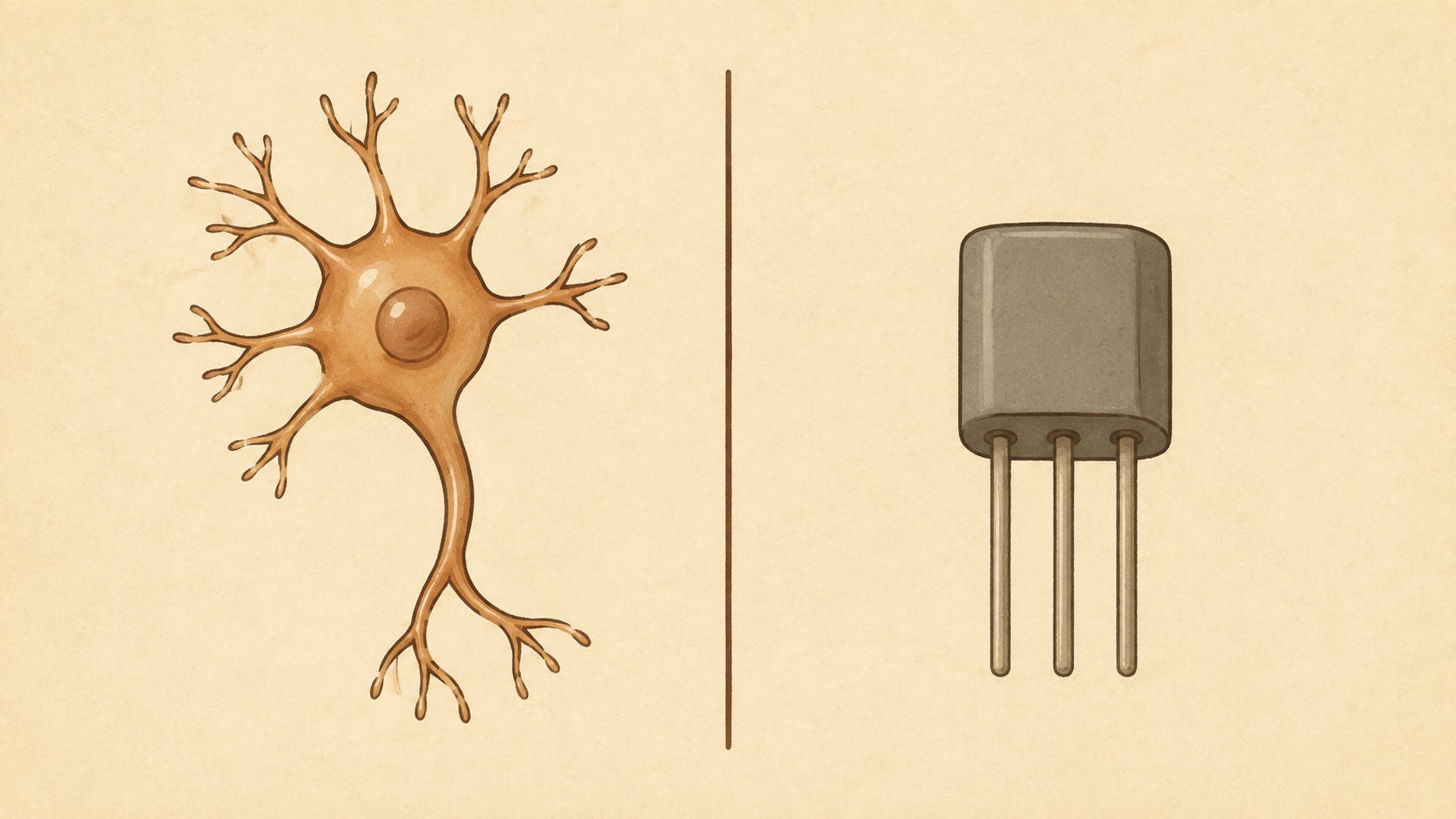
But does the “biological” view do any better? For starters, if its proponents want to claim that the “causal powers of the brain” are important to the occurrence of consciousness, don’t they owe us an explanation of what it is that the brain does that’s so important?
Some of them have proposed answers—Block argues that it might come down to electrochemical nervous systems, while Godfrey-Smith suggests it might be caused by large-scale electromagnetic fields caused by sub-firing neural activity (corresponding podcasts here and here)—but for any given proposal, it seems difficult to say why that thing would matter. Given this, we might think we have reason to defend computational functionalism until someone has proposed a more compelling causal alternative.
I think this is the wrong way to construct the dialectic. It assumes that opponents of computational functionalism have the burden of proof to provide an alternative. But that seems wrong. Computational functionalism is not a weak view we can rely on until a better option comes along. Given this, if we ask its critics, “What else might matter except computations?”, I think a fine response is “Probably something, but I don’t know what”. We only need to say that something else is necessary, perhaps even in combination with those same computations. This could be something as basic as electricity being involved in the process in the right way.
This does not make artificial consciousness impossible. Perhaps whatever non-computational causal powers we think are necessary can also be realized in silicon. The sceptical response would go like this:
All examples we have of confirmed conscious things in the world are carbon-based organisms, with ourselves as the clearest examples. Furthermore, the general (not-just-computational) functions that our brains and nervous systems perform are heavily dependent on physiological, electrical, and biochemical processes that in turn depend on the causal properties of carbon. We don’t know which of these are necessary or sufficient for consciousness in us, but it seems plausible that whatever they are, they too require carbon to be performed. Given this, we should not assume that we can replicate them in silicon, unless we have better evidence about what they are and whether they can be supported in silicon or other substrates.
Although we remain largely in the dark about what is necessary for consciousness, my view is that matter probably matters, because it constrains the causal influences that plausibly make a difference. And given that all examples of consciousness we have are in meat, we should not assume the same causal influences can be replicated in not-meat.
Final takeaways
Are you convinced to give up on computational functionalism? Well, you shouldn’t be, at least yet!
My aim here has been to articulate the basic case for scepticism, which I do agree with. But I have not presented the whole debate, including what many take to be the strongest argument for computational functionalism, namely the idea that functional mental states and consciousness should “go together”, as illustrated by Chalmers’s fading and dancing qualia arguments. You should read the discussion around it and see if that changes your view. I plan to write a post on why it doesn’t convince me.15 In case it does convince you, know that I have also not discussed much what many take to be the strongest arguments against it, namely the so-called triviality arguments and the difficulty with articulating a robust account of computation.
I should also flag that I would find computational functionalism a much more plausible account if I thought that consciousness was in some sense an “illusion”. If it were nothing over and above the computations that—we assume—constitute thought, then we could largely set aside the question of whether something causes it. Similarly, if it turned out that everything was conscious and computations merely modulated the experience, I could also be more amenable to the view if I squinted. I struggle to believe either of these views, however.
Most importantly, rejecting computational functionalism is not enough to reject the possibility of artificial consciousness, even if it makes it less likely. It is then an empirical question what non-computational processes cause conscious states, and whether those can be replicated in silicon-based digital computers, or other technologies we might invent.
To keep the main text accessible, I’ve aimed to put most technical discussions in the footnotes. People who are already familiar with the discussions might want to keep an eye on them.
We will assume that digital computers can compute anything our bodies can, pace Penrose (1989) and others. Note that rejecting this assumption would be an independent reason to reject computational functionalism, over and above anything discussed here.
Specifically, if the thing can emulate a universal Turing machine.
Anil Seth recently published a prominent expression of this scepticism too. I found myself comparatively unpersuaded by this criticism, and think that his view is less representative of the kind of view I will end up endorsing here, so I set his view aside.
For some representative discussions assuming that whole-brain emulation would be sufficient for consciousness, see e.g. Bostrom 2003 and Karnofsky 2021.
It continues: “Okay, but even if it doesn’t generate any gravity in our world, it does for subjects in the simulation.” No. At this point in the discussion, the question of whether there could be experiencing subjects “in” a simulation is exactly what’s at stake. We cannot assume this to argue for computational functionalism. One way of doing so would be to show that simulations preserve properties in our world, whether that’s consciousness or gravity. But that seems false for gravity.
There is a substantial question about when something really computes a particular computation. The most prominent proposal in this part of the literature is provided by Chalmers (1993/2011) of dualism fame. He argues that computing requires a “counterfactually robust” mapping to a mathematical object, meaning roughly that if something had happened differently in the implementing object, it would have moved to another state that also corresponded to a computational state that preserved the mapping. He formalizes this idea using the notion of a combinatorial state automaton. This is essentially a set of vectors mappable to parts of the implementing thing, and a transition function specifying how different sets of such vectors follow each other under different conditions.
Importantly, there is no consensus that Chalmers’s proposal of when something computes a computation is correct, nor for any other proposal. For example, Chalmers’s view is arguably subject to Maudlin’s (1989) “Olympia” objection, which was recently developed by Shiller (2026). The lack of a clearly defensible account is a deep–possibly the deepest–problem for computational functionalism, because unless there is some determinate answer to whether a computation is running, computational functionalism implies that there is no determinate answer to whether something is conscious. In the worst case, computation is merely a matter of human interpretation. That would mean that whether I am conscious would depend on whether others interpret my brain to be computing. And since that is false, it would constitute a reductio for computational functionalism. See the work of Gualtiero Piccinini for particularly in-depth discussions of this. I set these issues aside here.
For more on how computers work, I thoroughly recommend the lovely book Code, by Petzold (1999/2022). The first few chapters of The Laws of Thought, by Griffiths (2026), give a great overview of the early history of computational approaches to cognition as well.
This is completely sidestepping a big debate about what makes something a function in general, as opposed to something done accidentally, for example. As this is not central to the point I’m making here, I’m setting aside the point. See the work of Andrew Rubner for some of the most up-to-date discussions of this.
A wonky aside: My reading of Cao (2022) is that when she claims that substrate constrains function, she means that it constrains thick function. Because given the idea that computations are substrate invariant, I don’t understand how substrate could constrain thin computational function, except in its practical implementation (e.g. the efficiency of running it). I suspect different uses of ‘function’ might be a point of confusion between her view and computational functionalists.
Chalmers (1993/2011) calls such properties organizational invariants, and defines them as preserving the fine-grained causal topology of an object. I avoid this language here, because I think it’s difficult and slightly confusing in this context. One implication that is worth spelling out in these terms from the discussion above: preservation of causal topology or organization does not imply the preservation of causal properties or powers. An implemented computation might preserve the causal topology of Jupiter without preserving its causal powers, such as its ability to attract moons.
There are tricky nuances here, however. Computations are often assumed to be syntactic objects with no necessary content, while mental states are thought to represent the world: I desire things in the world, such as beer. This suggests that merely implementing a syntactic computation is insufficient to have a mental state, and that you also need some kind of causal connection to the world to make that computation “connect” with things.
This is not obvious. See Mandelbaum (2022) for an argument that not even belief can be understood computationally.
This is me just rejecting what Chalmers calls type-A materialism, which roughly says that consciousness is in some sense an illusion. This is a great point for you, dear reader, to push back on. Even if you disagree, I think it’d be interesting to note how much weight that view might be carrying for our confidence in computational functionalism. And lest you worry that all computational functionalists embrace type-A materialism, Chalmers himself rejects it, and embraces computational functionalism. (To be honest, I might be rejecting more than type-A materialism here, potentially type-B materialism too. I’m unsure and would be happy to get comments on this.)
In short, I broadly agree with Godfrey-Smith’s (2024) response.
This may just be a verbal dispute, but my interpretation/recollection of various of the people you characterize as rejecting computational functionalism is pretty different. "Substrate constrains function" sounds to me much more like a way of saying that even if computational functionalism is true, you might not be able to get non-biological substrates to reliably perform the particular computations that are characteristic of (constitutive of?) consciousness. That's how I recall Godfrey Smith, at least. As I remember him, he's basically granting computational functionalism, but then saying that all the action when it comes to the question of the practical possibility of non-biological consciousness is in just which computations matter, and whether it's feasible to do those computations in non-biological systems. And he has various hypotheses about distinctively biological features that might be an important part of how wet, squishy organisms process info, that might be very hard to replicate in silicon.
To use a very strained analogy, it's a pretty salient fact today that some computer chip designs are a lot better than others at doing the massive training runs you need for contemporary AI. Of course, it's all computation, so by the Church-Turing thesis in principle any computation you can do with one chip you can do with another. But "in principle" can be very far from "in practice." I thought of people like PGS and Cao as making a similar claim about biological systems being uniquely well-suited to perform the computations that matter for consciousness.
PS. OK here's a direct quote from PGS's "Mind, Matter, and Metabolism" that captures what I had in mind: "The view defended here can be expressed as a kind of functionalism. "Functional" properties in the sense relevant to philosophy of mind are grain-specific. Any system has coarser and finer grained functional features. Long-standing habits in discussion of functionalism have accustomed people to the idea that rather coarse-grained functional profiles are the ones that are most relevant. Against that background, arguments about the importance of the metabolic can be expressed by saying that a set of fine-grained functional properties of living systems matter more than is usually supposed."
As a “computational functionalist” (assuming “computation” is just a form of information processing), I wanted to make 2 comments:
1. You seem to be influenced by the “simulated rainstorm doesn’t make anything wet” argument. (Thankfully you didn’t use Kastrup’s simulated kidneys). The computational functionalist (well, my) response is that yes, simulated rain does make things wet … in the simulation. The simulated umbrella gets wet. The simulated Jupiter would revolve around the simulated sun. A simulated person would make all the same arguments that he is conscious, and for the exact same reasons that you would argue that you are conscious. I’ll say it again … the exact same reasons. We could be in a simulation now. How would you know? Answer is you can’t know (unless the simulator somehow informs you).
2.You wrote:
“The fact that we have a phenomenology might be caused by some computation, but I struggle to imagine what it would mean for the phenomenology to just be a computation: it seems like an independent phenomenon of some kind, and the question is what in the world causes it.”
The phenomenology is not a computation. It’s a perspective on computations. Consider a system that has a camera, can recognize just a few (say 10) things, and responds to those recognitions by sending tokens to an LLM which has been trained on those tokens. The LLM has a perspective on those recognitions. It doesn’t know about the tokens. All it can say is that things are recognized, or not. From its perspective the recognitions are just given. The whole system’s Umwelt is those ten things (plus words presumably). Everything it can say about those recognitions would line up with what you say about your phenomena. It has them, it knows it has them, but it can’t tell you what it is that it has. Sounds familiar.
Whatcha think?